






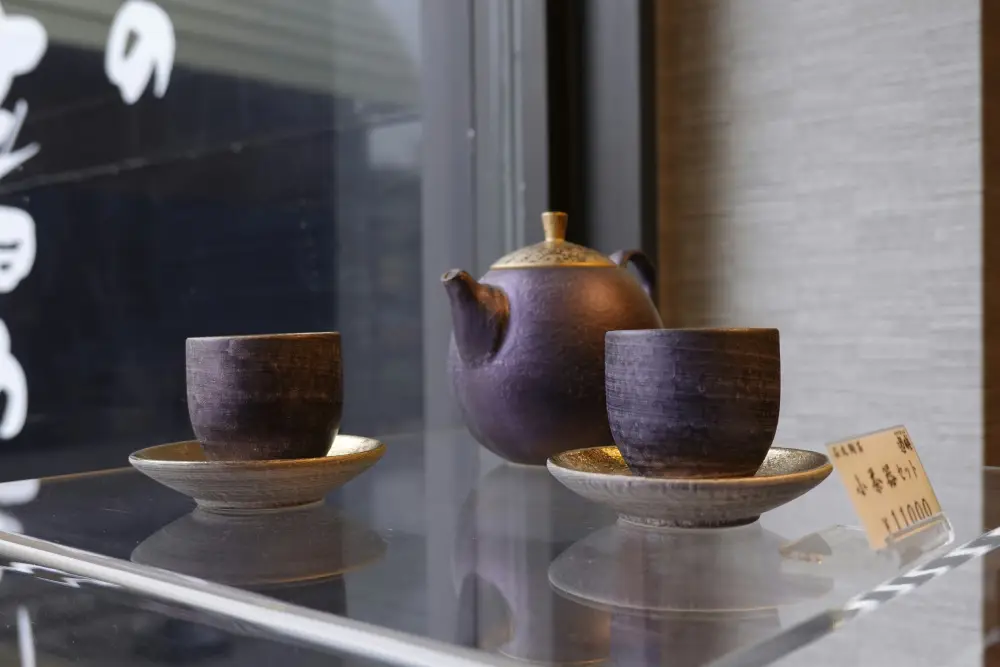
Japanese Ceramics is a small English-language shop for antique and vintage Japanese pottery. We travel to antique shops, flea markets and dealers' back rooms across Japan, based in Nagoya, and buy old pieces one at a time: tea bowls, cups, plates, vases, sake ware and serving dishes. Nothing is made for us and nothing is made to order. Every item is second-hand, already decades or centuries old, and sold as a single piece.
What Japanese Ceramics is
We are buyers and sellers of used Japanese pottery, not a manufacturer or a studio. The shop exists because so much good old ware sits unlabelled in Japanese antique shops, priced by the shelf rather than by what it is, and almost none of it reaches buyers outside Japan. Our job is to find it, identify what can honestly be identified, and describe it in plain English.
That means we never take commissions for new work and we never restock. When a piece sells, it is gone. If you want a sense of the range, the whole collection is the fastest way to see how varied a week's hunting can be.
We write this journal for the same reason. Old Japanese ceramics carry a lot of vocabulary, and a buyer overseas has little chance of learning it from a listing title alone. The articles here cover kilns, glazes, eras, marks and care, so that a bowl described as Mino or Seto or Tokoname means something concrete to you before you buy.
Where the pieces come from
Most of what we carry is found within reach of Nagoya, in the old ceramic heartland of central Japan. Seto and Tokoname are close by, Mino and Gifu a short drive north, and the region's antique markets are thick with everyday ware from these kilns: ash-glazed bowls, iron-brown Seto tea cups, unglazed red Tokoname teapots, Mino plates in oribe green and shino white.
Seto is the source of the word setomono, still used in Japan as a general term for ceramics, which tells you how central the area has been. Tokoname is one of the Six Ancient Kilns and is best known today for the reddish unglazed clay used in kyusu teapots. Mino, over the prefectural border, produced the shino, oribe, ki-seto and setoguro wares that define a huge part of Japanese tea taste.
We also buy further afield when a trip justifies it, so Karatsu, Hagi, Kyoto, Bizen and Arita pieces turn up regularly. Age ranges from Meiji and Taisho to the Showa decades, with older work when we can verify it. Some pieces arrive with a tomobako, the signed wooden storage box that came with them; most do not, and we say so.
How we choose a piece
We buy with the hand as much as the eye. A photograph will not tell you whether a cup is too heavy for daily use, whether the foot ring was trimmed with care, or whether the glaze pools in a way that rewards a second look. Those are the things we check in the shop, before anything is bought.
Beyond that, the filter is simple:
- Character over perfection. A slightly warped rim or an uneven glaze run is usually why a piece is worth carrying.
- Honest age. We prefer pieces with visible use: soft wear on the foot, tea staining inside a yunomi, an old lacquer repair.
- Usable where possible. Most of what we find is everyday ware and was meant to be used, not sealed in a cabinet.
- No guessing at attributions. If a mark is unclear or a kiln is uncertain, we describe the piece and leave the attribution open.
How the drops work
- We hunt. Buying trips happen continuously, and everything is chosen in person, in hand.
- We clean, photograph and research. Condition is noted honestly, including chips, hairlines and old kintsugi (gold-lacquer repair), which in Japan is part of a piece's history rather than a defect.
- We publish a drop. New pieces go up in batches. Each listing is a single object with its own photographs and measurements.
- It sells or it waits. There is one of each. We ship worldwide, packed for the journey.
Because there is no reordering, the shape of the shop changes constantly. A run of Seto tea cups one month may be followed by a set of Meiji porcelain plates the next, depending entirely on what the markets give up.
What you can browse
CategoryWhat tends to appear BowlsTea bowls, rice bowls, deep serving bowls in Mino, Seto and Karatsu styles CupsYunomi tea cups, guinomi sake cups, cup sets TokkuriSake flasks, from plain stoneware to painted porcelain PlatesSmall mame-zara dishes up to large platters VasesIkebana and display vases, bronze-form and kiln-fired TeawareKyusu teapots, chawan, water jars and tea utensils ServingwareLidded pots, mukozuke, multi-piece sets Art ObjectsFigures, incense holders, kiln oddities and one-off formsBuying antique Japanese pottery from abroad
The main thing to accept is that old pottery is not new pottery. Glaze crazing, kiln grit on the foot, slight warping and colour variation are normal and often the reason a piece is interesting. We list flaws rather than hide them, and we price accordingly.
If you are starting out, a cup or a small plate is the cheapest way to learn what you actually like in the hand. Weight, foot ring finish and the feel of a lip against your mouth tell you more than photographs ever will. Buy one, use it for a month, and your eye for the next one will be far better trained.
Packing matters as much as picking. Pieces travel a long way, and old ceramics with existing hairlines need more protection than sound ones. More on our sourcing approach and how we work is on the about page.