







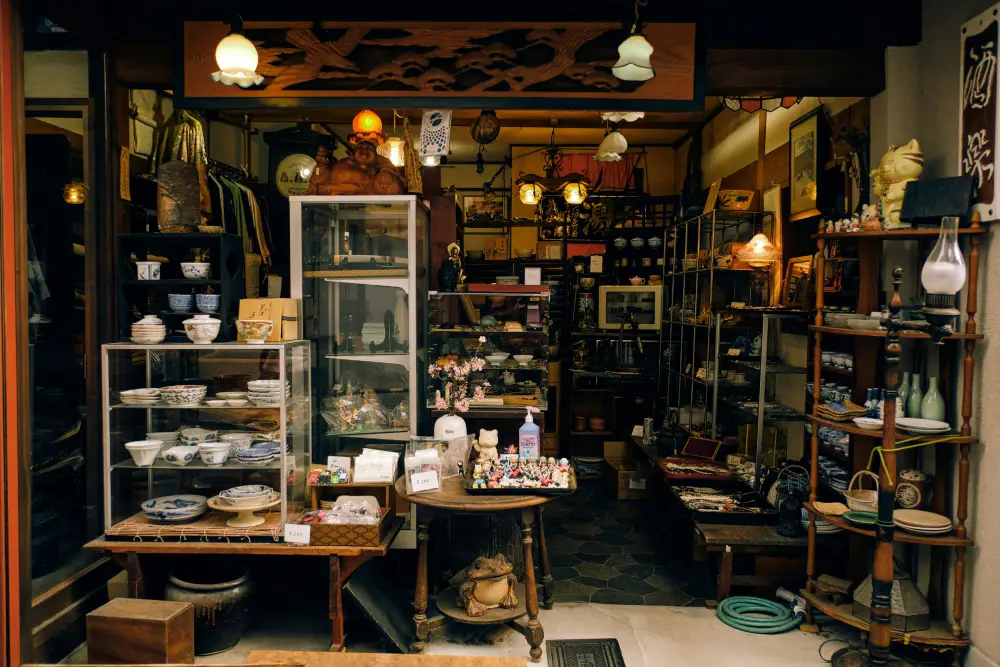
Antique Japanese pottery is stoneware and earthenware made in Japan roughly a century or more ago, while antique Japanese porcelain is the whiter, harder, higher-fired ware from kilns such as Arita and Kutani. Both are widely available second-hand, from a few tens of dollars for a Meiji-era sake cup to serious sums for signed tea ceremony pieces. Condition, kiln, age and whether the piece still has its original box drive the price.
What counts as antique Japanese pottery?
In the trade, antique usually means made before about 1920, and vintage means anything older than roughly forty years but younger than that. Japanese dealers rarely use those words. They date pieces by era instead: Edo (1603 to 1868), Meiji (1868 to 1912), Taisho (1912 to 1926), Showa (1926 to 1989).
That era language matters when you buy. A seller who says "Showa period" is telling you the piece could be anything from 1926 to 1989, an eighty-year span covering both hand-thrown farmhouse ware and mass-produced export goods. A seller who says "late Meiji" is making a much narrower claim, and should be able to say why.
The other distinction worth keeping straight is toki (pottery, meaning earthenware and stoneware) versus jiki (porcelain). Together they are tojiki, the general word for ceramics. Pottery is opaque, usually heavier, and often shows bare clay at the foot. Porcelain is thinner, rings when tapped, and lets light through at the rim if you hold it up.
Pottery or porcelain: which should you buy?
Buy pottery if you want texture, warmth and visible making; buy porcelain if you want painting, crispness and durability. Neither is inherently more valuable. The table below covers the practical differences that affect how a piece behaves on your table.
Antique pottery (toki)Antique porcelain (jiki) Typical kilnsBizen, Shigaraki, Hagi, Karatsu, Mashiko, Oribe, TokonameArita/Imari, Kutani, Hirado, Seto, Kyoto porcelain FeelWarm, granular, often unglazed at the footCool, smooth, glassy TranslucencyNoneSlight at thin edges DecorationGlaze effects, ash, iron, kiln marksPainted cobalt blue, overglaze enamels, gold Common flawsChips to the rim, glaze crazing, stainingHairline cracks, enamel wear, gold rubbed off Everyday useFine, but porous types stain and hold odourVery robust, though enamels dislike scrubbingMost collections end up mixed, and that is a good outcome. A blue-and-white Arita plate and a rough Bizen tokkuri (a sake flask) sit together happily because Japanese table culture has always combined materials rather than matching them.
The kilns to know before you buy
A handful of kiln names cover most of what you will meet in antique shops, and recognising them is the fastest way to buy well.
- Arita / Imari: Japan's first porcelain, from Saga Prefecture. Blue-and-white and polychrome enamels. Imari is the port it shipped from, not a separate kiln.
- Kutani: Ishikawa Prefecture porcelain, known for bold overglaze enamels in green, yellow, purple and red, often with dense painted grounds.
- Seto: Aichi Prefecture, so central to Japanese ceramics that setomono became the everyday word for crockery. Both pottery and porcelain.
- Bizen: Okayama, unglazed high-fired stoneware. Colour comes entirely from fire, ash and the way pieces were stacked.
- Shigaraki and Iga: Shiga and Mie, coarse clay with visible feldspar specks and natural ash glaze.
- Hagi: Yamaguchi, soft pinkish-white glazes that craze and slowly stain with tea, a change collectors call the seven transformations.
- Karatsu: Kyushu, iron-painted or plain stoneware with a strong Korean lineage, long favoured for tea.
- Mashiko and Tamba: folk-craft kilns, thick glazes, honest utilitarian shapes, most examples twentieth century.
Region shapes what turns up where. Our own hunting is concentrated in central Japan, and we have written about what that means for the pieces that surface in antique and vintage ceramics from the Nagoya area.
How to tell genuine age from a convincing fake
Age shows in wear patterns that are hard to fake, not in the mark on the base. Marks are the least reliable evidence on Japanese ceramics, because kiln names, auspicious characters and Chinese reign marks were all copied freely and legally for centuries.
- Turn it over first. The foot ring should show soft, uneven abrasion where it met tables for decades, not uniform scratching in one direction.
- Look at the glaze pooling. Hand-applied glaze thickens unevenly and often stops in an irregular line above the foot. Machine-applied glaze is suspiciously even.
- Check crazing for dirt. Genuine old crazing has darkened lines, because grease and tea worked into the cracks over years. Fresh crazing is clean and colourless.
- Feel the weight. Hand-thrown pieces vary in thickness across the wall; slip-cast reproductions are uniform and often lighter than they look.
- Read the painting. Old cobalt under the glaze has depth and slight bleed. Modern transfer printing shows a dot pattern or a hairline join where the paper met.
- Treat the box as supporting evidence. A tomobako, the signed wooden storage box, adds a great deal when the calligraphy matches the piece, but boxes and pieces get separated and remarried all the time.
None of these tests is conclusive alone. Three of them agreeing is usually enough for anything below the level where you would want a specialist opinion.
What affects the price of antique Japanese pottery?
Condition first, then attribution, then rarity of form. A perfect unsigned Meiji plate frequently outsells a chipped one by a named maker, because most buyers want to use what they buy.
Japanese collecting has an important quirk here: repair can add value rather than destroy it. Kintsugi, joining breaks with lacquer and gold, is a respected tradition, and a well-executed old repair is part of a piece's history. Cheap modern glue repairs are a different matter and should always be disclosed.
Form matters more than people expect. Sake ware, tea bowls and small serving dishes survive in quantity because households owned sets of them; large vases, unusual water jars and complete sets survive far less often, and price follows scarcity. Browsing by shape is a practical way to learn this: compare what happens across antique bowls, cups and vases and the pattern becomes obvious quickly.
Where to buy, and what to ask
You can buy from Japanese antique markets, international auction houses, general marketplaces or specialist dealers, and each trades price against certainty differently. Markets are cheapest and riskiest. Auction houses are safest at the top end and expensive below it. Specialist dealers sit in between, and the good ones tell you what they do not know.
Whoever you buy from, ask four questions: what period, on what evidence, what is the exact condition including hairlines, and is there a box. A seller who answers "Showa, no box, hairline at the rim, 3cm" is more trustworthy than one who answers "rare antique, excellent condition".
Our shop works one piece at a time, buying second-hand in Japanese antique shops rather than commissioning anything new, so every listing is a single object with its own history. You can see the whole collection of antique and vintage Japanese ceramics, or read how we find and vet each piece before you buy.
Living with what you buy
Most antique Japanese ceramics can be used, with a few sensible limits. Hand wash everything. Keep unglazed and crazed pottery away from dishwashers and long soaks, because water gets into the body and takes days to leave. Never microwave anything with gold or silver decoration.
Season porous stoneware before first use by soaking it in water, or in plain rice water for tea ware, then drying it slowly. Store pieces unstacked, or with a sheet of felt or paper between them. Old glazes are softer than modern ones and rim chips almost always start as stacking damage.