







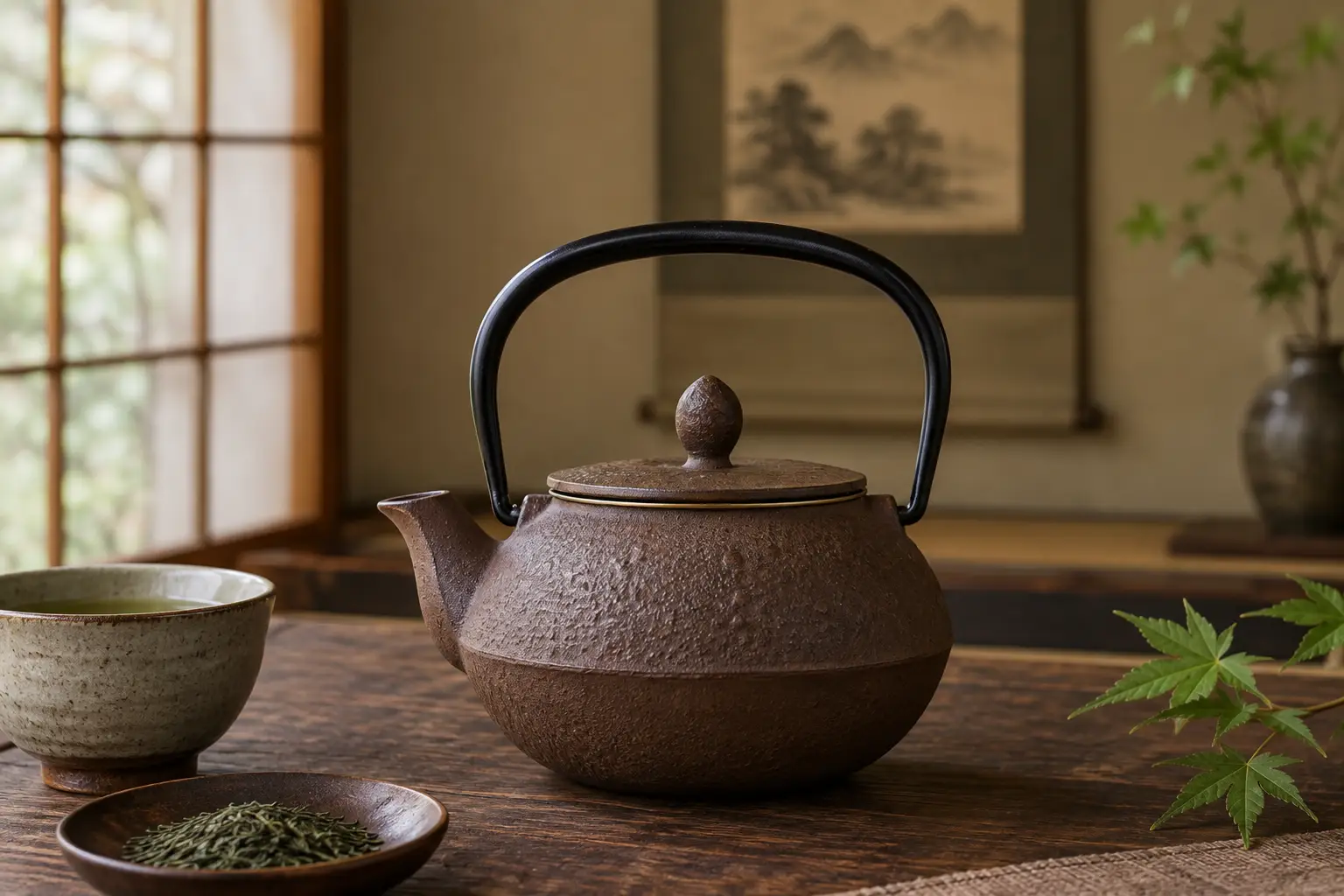
A kyusu is a Japanese teapot made for steeping leaf tea, usually green tea, with a strainer built into the body so the leaves stay behind when you pour. The classic form has a hollow handle set at right angles to the spout, and the best known are the unglazed red clay teapots of Tokoname in Aichi Prefecture. Vintage examples are widely found, still usable, and judged on lid fit, pour and the condition of the strainer.
What is a kyusu?
Kyusu (急須) is the general Japanese word for a teapot used to brew leaf tea, and in practice it means a small pot of roughly 200 to 360 ml with an integral strainer. Size matters because Japanese green tea is brewed short, in small volumes, and poured out completely each time.
The strainer is the defining feature. It can be a patch of small holes drilled through the wall behind the spout, a fired clay mesh (sasame or obiami), or a fitted stainless steel screen. A Japanese teapot with an infuser basket that drops into the pot is a different, more export-oriented design, and it brews differently because the leaves cannot open freely in the water.
Handle types you will meet
- Yokode kyusu (side handle): the standard form, handle at 90 degrees to the spout, made to be poured one-handed with a low wrist.
- Ushirode kyusu (back handle): handle opposite the spout, like a Western teapot, common in larger sizes and in Banko ware.
- Uwade kyusu (overhead handle): a bail handle of metal, rattan or clay over the top, often on bigger pots for houjicha or bancha.
- Houhin and shiboridashi: handleless pots for high grade gyokuro and sencha brewed cool, gripped by the rim.
Why Tokoname teapots are the classic choice
Tokoname, one of the Six Ancient Kilns of Japan, has made teapots in iron-rich local clay since the nineteenth century, and its unglazed red pots became the default kyusu in Japanese homes. The clay fires to that familiar vermilion brown, called shudei (red clay), and the surface is left bare inside and out.
The practical argument for unglazed Tokoname is that the porous iron-bearing clay is said to soften the taste of green tea by taking the edge off bitterness. Whether or not you accept that, the pots are thin-walled, light, and made by potters who specialise in nothing else, so the lid seats accurately and the spout cuts off cleanly.
Tokoname also produced the most refined strainers. A sasame strainer, a fan of tiny holes pierced through the wall, catches fine sencha leaf without slowing the pour, and a ceramic strainer never rusts or taints the tea the way a neglected metal screen can. If you are looking at vintage kyusu and Japanese teapots, this is the style you will see most often.
Tokoname sits just south of Nagoya, and the kilns of that region turn up constantly in the antique shops we work through. We have written more about the area in our piece on antique and vintage ceramics from Nagoya.
Tokoname, Banko, Hagi and Arita teapots compared
The short version: Tokoname and Banko are unglazed clay pots that suit green tea, while Hagi, Arita and Kyoto pots are glazed or decorated and are chosen as much for looks as for brewing.
WareBody and surfaceTypical strainerBest for TokonameUnglazed red or dark iron clay, thin wallsPierced clay sasame, or stainless meshSencha, fukamushi, everyday use Banko (Yokkaichi, Mie)Unglazed purple-brown shidei clay, often moulded or ribbedClay mesh or fitted metal screenSencha and houjicha, back-handle pots HagiSoft pale glaze with crazing, absorbent bodySimple drilled holesDisplay and gentle use; stains with age Arita / HasamiWhite porcelain, painted in blue or enamelsDrilled holes or metal basketAny tea, easy to clean, no flavour carry-over Kyo-yaki / KiyomizuFine glazed stoneware, painted decorationDrilled holes or metalGuests, sencha served formallyA porcelain pot is the safe first buy if you drink several kinds of tea, because it holds no flavour. An unglazed pot rewards you for using it for one tea only, and it darkens and gains a sheen over years of use.
How to check a vintage Japanese teapot before you buy
Check the lid, the strainer, the spout and the body, in that order, because those are the faults that make a teapot unusable rather than merely worn.
- Lid fit. Set the lid in place and turn it. It should rotate smoothly and sit level with no rocking. A lid that binds or gaps was either warped in the firing or belongs to another pot.
- Strainer condition. Look through the holes against the light. Clay strainers chip; metal screens rust, detach or get pushed out of shape. A damaged screen can sometimes be replaced, a broken clay mesh cannot.
- Spout tip. Run a fingernail round the rim of the spout. Chips here are common and they cause dribbling, which no amount of technique fixes.
- Hairlines. Hold the pot by the lid knob recess or balance it on your fingers and tap the body lightly. A clear ring suggests a sound body, a dull thud suggests a crack, sometimes invisible under a dark clay surface.
- Handle join. On side-handle pots the handle is luted on, and that seam is the weak point. Look for filled lines or a colour change where a repair was made.
- Interior. Old tea residue is normal in an unglazed pot and part of its history. Mould, or a sour smell that survives a boiling water rinse, is not.
- Marks and box. Many kyusu carry a stamped or incised maker's seal under the base or on the handle. Some arrive with a tomobako, the signed wooden storage box, which supports an attribution but is not proof on its own.
Our broader buyer's guide to antique Japanese pottery goes further into marks, repairs and how condition language is used.
Is a vintage teapot safe to drink from?
Yes, with sensible checks. Unglazed Japanese clay bodies fired at stoneware temperatures are inert, and the risk with decorated wares comes from painted overglaze enamel or gilding, which belongs on the outside of a pot, not the inside where tea sits.
Avoid brewing in a pot with a crack that runs through the wall, because water seeps into the body and will not dry out. Pots with old lacquer or kintsugi repairs (joined with urushi lacquer and gold) are usually fine for tea at normal brewing temperatures, though many collectors keep repaired pieces for display.
How to use and care for a kyusu
Brew short and pour out every drop. For sencha, roughly 5 g of leaf, water around 70 to 80 degrees Celsius, and one minute for the first infusion, then shorter for the second and third.
- Warm the pot first, especially in winter, so the temperature does not drop through the clay.
- Pour to the last drop, shaking the final few out. Tea left standing turns bitter and stains.
- Empty the leaves straight away, rinse with hot water, and leave the lid off until the pot is dry inside.
- Never use soap on an unglazed pot. It soaks into the clay. Hot water and a soft brush are enough.
- Do not put a kyusu in the dishwasher, on a flame, or in a microwave. Thermal shock and detergent both end these pots.
- Keep one unglazed pot for one type of tea. Houjicha and sencha in the same pot muddle both.
If a metal strainer clogs, soak the pot in hot water with a little baking soda, then brush from the inside outward so the debris comes back into the body rather than deeper into the holes.
Buying a vintage kyusu rather than a new one
Second-hand Japanese teapots are abundant in Japan because almost every household had one, and the ordinary ones were made to a standard that shames most new export teaware. Unsigned Showa-era Tokoname pots in good order are among the best value in Japanese ceramics.
The trade-offs are that you take the pot as it is: the strainer type, the capacity and any staining are fixed, and matching cups are a separate hunt. We look for pots with intact strainers, true lids and clean spouts, and the search usually runs alongside the rest of the teaware, since a kyusu, a yuzamashi (water cooler) and a set of small cups were often bought together and sometimes stayed together.