








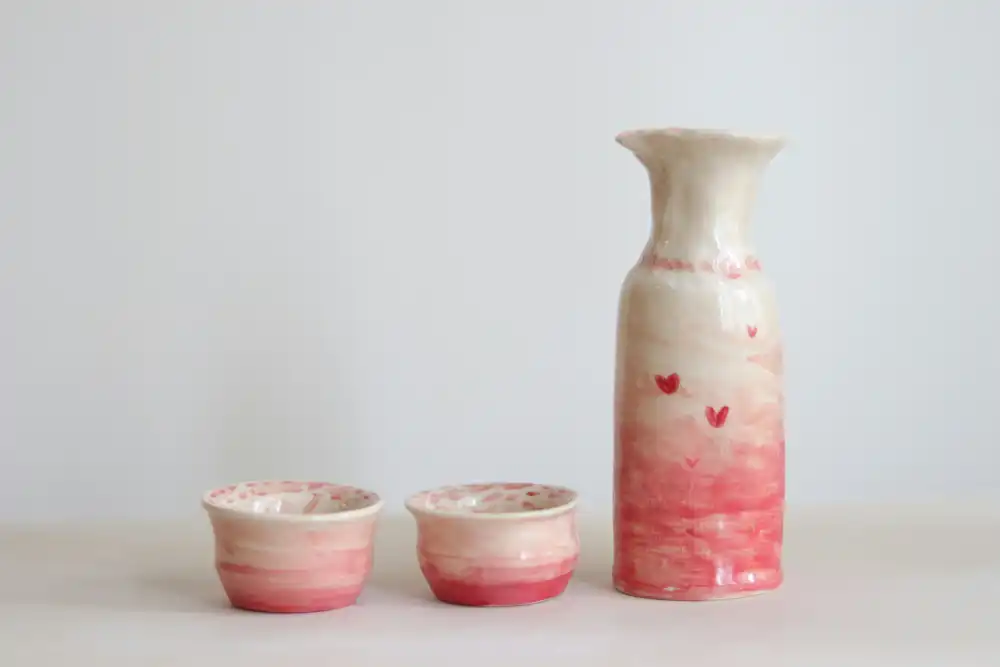
A Japanese sake set is usually a tokkuri (a narrow-necked serving flask) with two or more small cups, either ochoko (thin, shallow cups) or guinomi (deeper, heavier cups). Sets may also use a katakuchi (a lipped pouring bowl) instead of a flask. Vintage sets come from kilns such as Mino, Karatsu, Hagi, Bizen, Tokoname and Kyoto, and most were made for everyday use at home.
What is in a Japanese sake set?
A standard set is one flask and two cups, sold together as a pair service for host and guest. Larger household sets add cups for four or five people, and formal sets sometimes include a lacquer or ceramic tray, or a chirori (a metal warming vessel used inside a pot of hot water).
The vessels are not interchangeable in the way Western glassware is. Each shape has a job, and the size of the piece tells you how the sake was meant to be drunk: quickly and warm, or slowly and cold.
- Tokkuri: the serving flask, typically 180 ml to 360 ml, with a shoulder that narrows to a neck so the pour is controlled and the sake holds warmth.
- Ochoko: the small cup, often 30 ml to 60 ml, thin-walled and made to be refilled constantly by whoever is sitting next to you.
- Guinomi: a larger, thicker cup, roughly 60 ml to 120 ml, closer to a small tea bowl and favoured by drinkers of cold or room-temperature sake.
- Katakuchi: an open pouring bowl with a folded spout, used for cold sake and for decanting from a bottle.
- Sakazuki: a wide, flat, shallow cup on a small foot, associated with ceremony, weddings and shrine offerings rather than daily drinking.
Tokkuri, katakuchi or bottle: which pouring vessel?
Choose a tokkuri if you drink sake warm, and a katakuchi if you drink it cold. The tokkuri's narrow neck slows evaporation and heat loss, which matters when the flask is standing in a bowl of hot water; the katakuchi's wide mouth lets chilled sake breathe and makes the aroma easier to catch.
VesselTypical useServing temperatureWhat to look for TokkuriWarmed sake, household diningWarm to hotClean drip-free lip, no crack at the neck, stable foot KatakuchiCold sake, decanting, also doubles as a small serving bowlCold to room temperatureSharp, well-formed spout; interior glaze free of heavy staining ChiroriWarming sake in a water bathWarm to hotMetal, not ceramic; check for pinholes and old repairsOchoko vs guinomi: how to choose your cups
Pick ochoko for warm sake and sociable pouring, guinomi for cold sake you want to linger over. Ochoko are small enough that the sake stays hot from the first sip to the last, which is the whole point when the flask has been heated; guinomi hold enough that you can swirl the liquid and smell it.
Weight and rim thickness change the experience more than people expect. A thin, crisp porcelain rim delivers a clean, sharp mouthfeel; a thick, slightly rounded stoneware rim softens the alcohol and suits earthier sake. If you are buying your first set, hold the cup to your lip before deciding, or at least read the listed rim diameter and weight.
Many vintage cups were sold in groups of five, the traditional Japanese set number, rather than the Western six. Finding a complete five-cup set with matching glaze and no chips is genuinely uncommon, so mismatched cups collected one at a time are a normal and respected way to build a table. We look for single vintage Japanese cups as often as full sets for exactly this reason.
Kilns and styles worth knowing
Sake ware was made at almost every Japanese kiln, but a handful of traditions dominate the second-hand market. Knowing them makes it much easier to read a listing or an antique shop shelf.
Stoneware kilns
- Bizen (Okayama): unglazed, high-fired, reddish-brown to dark grey with fire marks from the wood kiln. Prized for sake because the rough surface is said to soften the drink.
- Hagi (Yamaguchi): soft pinkish-white or loquat-coloured glaze with fine crazing. Hagi absorbs liquid over years of use and changes colour, a maturing effect collectors call nanabake, the seven transformations.
- Karatsu (Saga): grey-brown clay under ash or iron glaze, often with simple brushed iron decoration. Sober, quiet, very well suited to sake.
- Tokoname (Aichi): red clay stoneware, better known for teapots but a steady producer of tokkuri and cups. Our guide to Tokoname kyusu covers the clay in more detail.
- Shigaraki and Iga (Shiga and Mie): coarse, gritty clay with feldspar specks and natural ash glaze, at their best in rugged guinomi.
Mino and porcelain
- Oribe: green copper glaze over part of the piece, the rest left white with iron-brushed patterns. Instantly recognisable.
- Shino: thick, milky white feldspar glaze with pinholes and a warm orange blush where the glaze is thin.
- Kiseto: yellowish ash glaze, sometimes with green copper spots.
- Arita and Hasami (Kyushu): blue-and-white porcelain sake sets, printed or hand-painted, the most common household sets from the Showa era onward.
- Kutani (Ishikawa): bold overglaze enamels in red, green, yellow and gold, often with figures or birds.
Some Showa-era porcelain sets carry a novelty feature: a face painted in the base of the cup that appears as the sake level drops, or a whistling flask. These were mass-market items, cheap and cheerful, and are collected for exactly that reason.
How to buy a vintage sake set: what to check
- Count the pieces and compare the glazes. Vintage sets are often assembled after the fact. Check that cups share a clay colour and glaze, and that the flask is not a later substitution.
- Run a finger round every rim. Chips hide under glaze pooling on cup rims and on the tokkuri lip, where the pour wears the edge.
- Distinguish crazing from cracks. Fine crackle in the glaze is normal and often intended, especially in Hagi. A crack through the body will show as a dark line running over the foot or interrupting the rim, and will feel like a ridge.
- Look inside the flask. Old sake residue and mineral staining are common. Light staining is cosmetic; a persistent sour smell means the piece has been stored damp and needs a long clean before use.
- Check the foot ring. This is where the clay is exposed and where the kiln shows itself. Sand, wadding scars and an unglazed foot are good signs of a traditionally fired piece.
- Ask about the box. A tomobako, the signed wooden storage box that accompanies studio pieces, supports attribution and adds value. Many good everyday sets never had one, and that is fine.
- Read marks with caution. Base marks may be a kiln, a maker, a shop or a pattern name, and many are unsigned. Treat an unsupported attribution as a guess. Our buyer's guide to antique Japanese pottery goes further on marks and dating.
Serving and warming without damaging the piece
Warm a ceramic tokkuri in a water bath, never on direct heat and never in a microwave. Stand the filled flask in a pan or bowl of hot, not boiling, water for two to three minutes for nurukan (around 40C) or a little longer for atsukan (around 50C). Sudden temperature change is what cracks old glazes.
Unglazed stoneware such as Bizen, and porous glazed ware such as Hagi, should be rinsed with clean water and soaked briefly before first use so they do not draw sake straight into the body. Wash by hand with warm water, use detergent sparingly on unglazed clay, and dry the flask upside down and fully before putting it away, or it will smell.
Avoid the dishwasher entirely for vintage pieces, and never put gold or silver overglaze decoration in a microwave. Repairs done in kintsugi, the lacquer and gold technique, are not food-safe under heat and are better admired than filled.
Building a set piece by piece
You do not need a matched set. A common approach among collectors is one good flask, then cups chosen individually so each guest gets a different one, an arrangement Japanese hosts use deliberately so nobody confuses their drink.
Start with the flask, because it sets the scale and the mood, then add cups that echo its clay colour or deliberately contrast with it. A Bizen tokkuri with white Shino cups works; so does a blue-and-white porcelain flask with plain celadon cups. We hunt for both flasks and cups in antique shops across Japan, and list them on the sake ware pages along with related servingware that suits the same table.