







Item
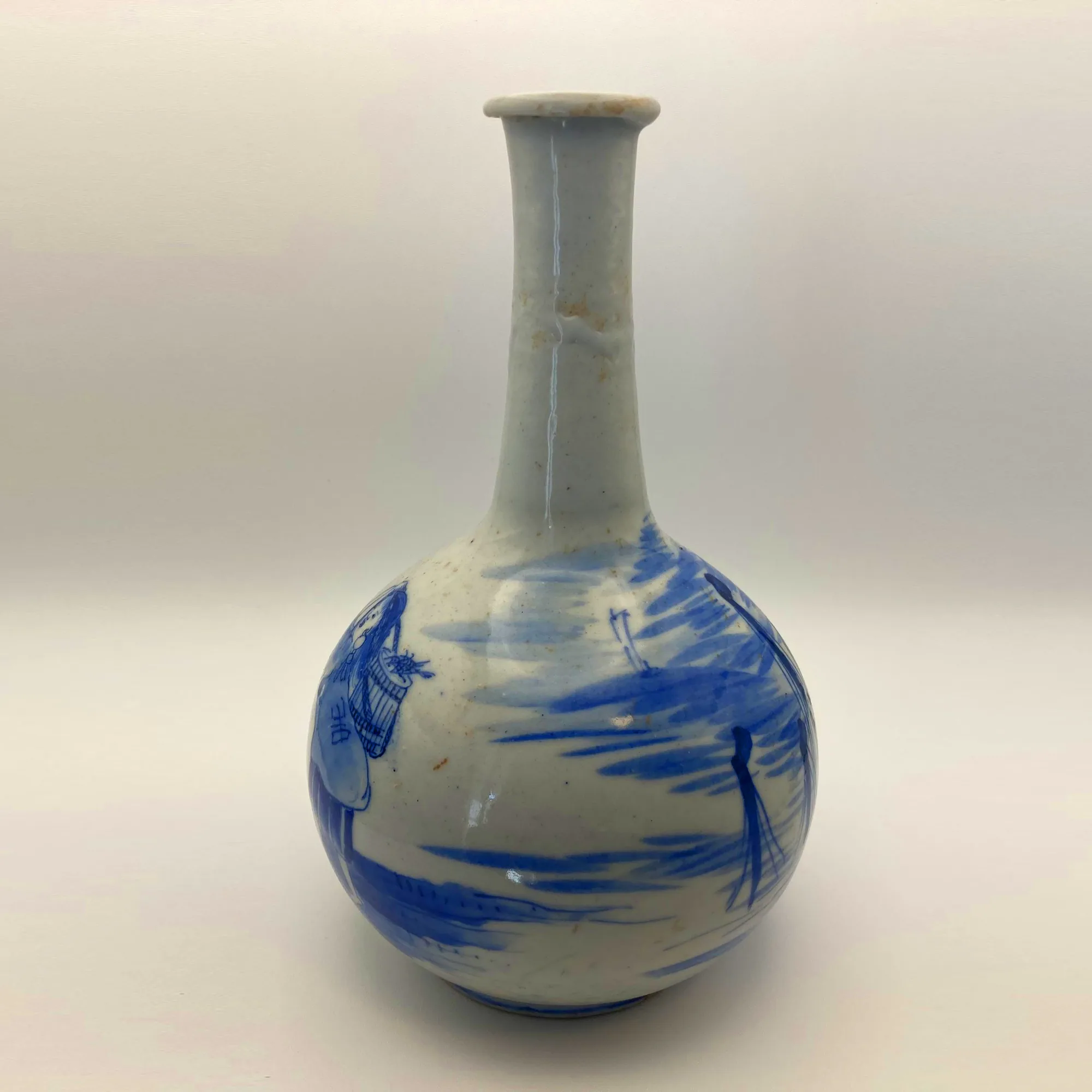
Antique Sometsuke Tokkuri, Blue and White Sake Bottle with Shell Gatherer by the Sea, Edo to Meiji Era, Japan
Late Edo to Meiji, roughly 1830 to 1890. The grey gritty clay on the unglazed foot, the crackled bluish glaze with iron freckles, the loose confident brushwork and the slightly wobbly neck all point that way. Kiln is harder to pin. The clay and glaze say Seto or Mino to me, which would make sense for where you're hunting, but Hizen (Imari) made similar bottles. I'd write "likely Seto" and leave room. Confidence: high on the era, medium on the kiln.
A sake bottle from a time when sake bottles were painted by hand, quickly, by someone who had done a thousand of them.
Round belly, long neck, small rolled lip. On the front, a figure with long loose hair carries a woven basket with a fish or shellfish tucked inside. Around the body, waves and reeds sketched in a few wet strokes of cobalt, a bit of a boat, a bit of shore. There are characters written on the figure's robe. I haven't fully worked them out, and I'd rather say that than make something up.
The glaze has a soft grey-blue tint and a fine crackle that has picked up a little brown over the years. There are small iron spots in the clay. The foot ring is unglazed and shows the rough grey clay body, with a bit of kiln grit still on it. All of that is normal for the period and it's part of why the piece feels the way it does.
Condition: no chips or cracks to the body. Crazing and staining throughout, as expected. [If repaired: an old repair at the neck, stable, visible on close inspection.] Holds water, but I'd use it for a single stem of something rather than a bouquet.
Anecdotes
Tokkuri like this were everyday things. In the Edo period a household would send someone to the sake shop with the bottle to have it filled, the way you'd take a growler to a brewery now. Painted ones were the nicer sort, kept for guests.
The figure with the basket by the water is probably an ama, one of the women who dived for shellfish along the Japanese coast for centuries, or a fisherman heading home. Sea scenes on sake bottles were a bit of a joke: sake, fish, a shore. Everything you need for an evening.
Seto potters started making blue and white porcelain seriously around 1807, when Kato Tamikichi came back from Kyushu with the secret. Within a generation Seto sometsuke was everywhere in Japan, and pieces like this bottle were being turned out in huge numbers. Very few survive without damage. This one made it.
Antique shop in central Japan, near the Seto pottery region
Measurements & materials
- Clay & glaze
- Grey, slightly gritty clay, visible at unglazed foot ring. Bluish transparent glaze with all-over crackle and light staining, iron spots
- Weight
- 797 g (1 lb 12 oz)
- Condition
- Good antique condition. Crazing, staining and iron spots throughout. No chips or cracks to body. Neck: see note above
Ready to ship. Packed and sent from Japan.
- Found in Japan, and the only one of it we have
- Condition described honestly, flaws photographed
- Shipped insured and tracked, worldwide
- Payment handled by our provider - we never see your card
Return it within 7 days of delivery, unused and in its original packaging. Return postage is paid by you. Full policy.
Payments are handled by Stripe. Your card details go into Stripe's own secure form and straight to them: they never reach our servers, and we do not store them.
Ships from Japan. Cost is calculated at checkout from your address; import duties and taxes in your country are not included. Shipping & returns in full.
More to discover
You may also like