







Plates
Antique Blue and White Dish with Crane over Waves, Bold Kiln Flaws, Edo to Meiji Japan
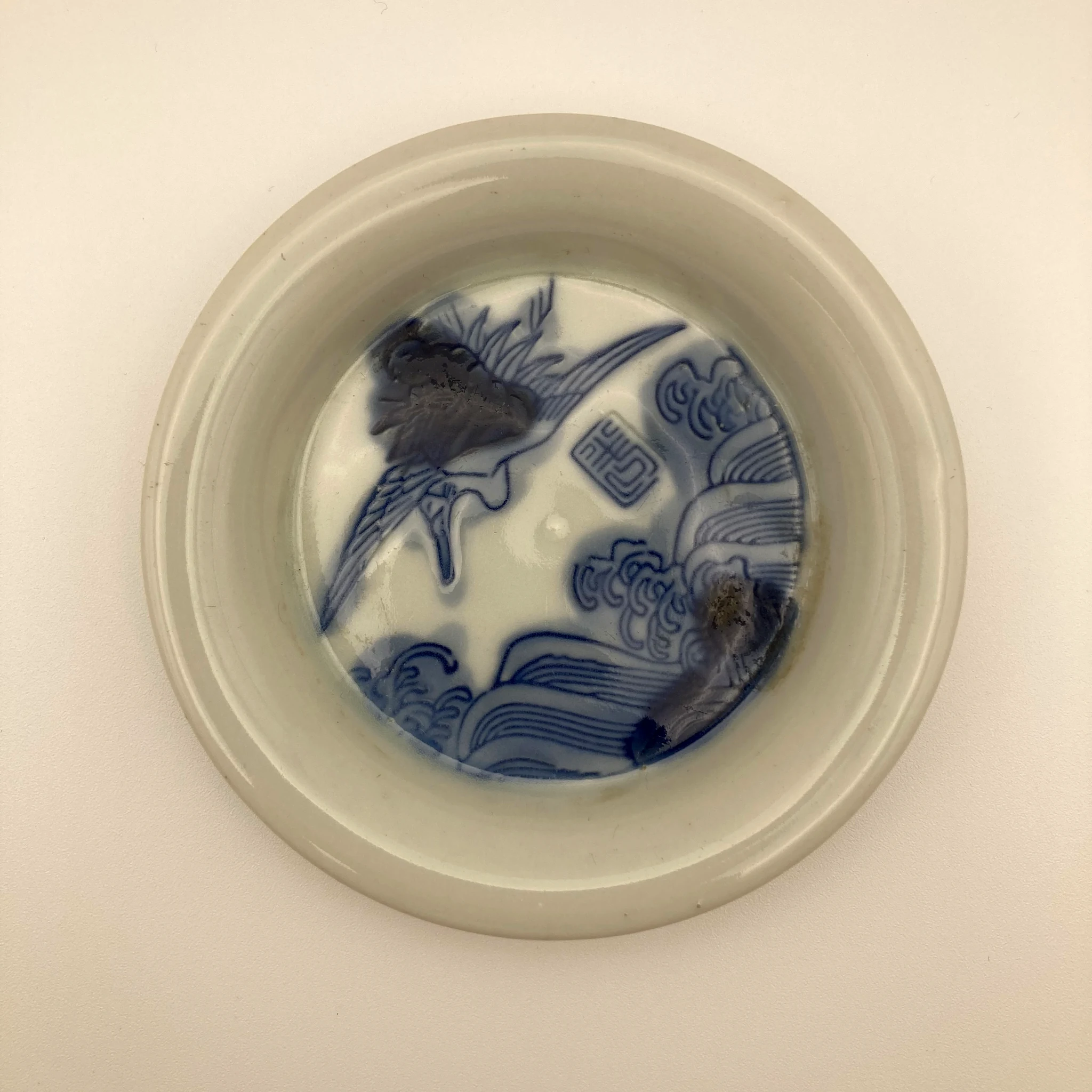
A crane flies over rough water. Next to it, a square seal mark, and around it, waves drawn in fine combed lines that fill the well of the dish. The rim is left plain, a wide ring of grey-white glaze, so the picture sits inside like a framed print.
Now the honest part, which is also the best part. When this dish was fired, somewhere around 150 years ago, the cobalt ran. Two patches flooded into deep ink-dark pools, one over the crane's wing, one in the waves, and the glaze pulled and roughened at the edge of one of them. A dish like this was probably tenth in a stack of thirty in a wood-fired kiln. Most of its siblings came out clean. This one came out with weather.
You can call that damage. Japanese collectors would call it keshiki, "landscape," the accidents that make one piece different from every other. Either way it happened in the kiln, not in someone's sink, and it's been part of the dish since day one.
Underneath, the foot ring still has kiln grit baked into it and an old scar where it stuck to its neighbor in the stack. Flip it over and you're looking at how these things were actually made.
Anecdotes
Crane over waves is a pairing with a message. The crane is long life, the endless waves are eternity, and together they were painted on dishes meant for celebrations. Cheerful pictures for New Year's tables, wedding meals, a grandfather's birthday.
The seal by the crane's beak is a decorative stamp of the kind workshops added to imitate Chinese porcelain marks. On pieces like this it's ornament, not a signature. The painter was anonymous, the dish was one of thousands, and its survival is pure luck.
Hand wash, no microwave. The rough glaze patch is stable but don't scrub it with steel wool.
Antique shop find, central Japan
Measurements & materials
- Clay & glaze
- Grey-white body, soft grey-tinged glaze, underglaze cobalt with heavy flow flaws, kiln grit on foot
- Kiln
- Seto or Mino, unmarked
- Era
- Late Edo to early Meiji, c. 1840 to 1880
- Dimensions
- 13 cm diameter, 3 cm tall
- Weight
- 89 g (3.1 oz)
- Condition
- Structurally excellent, no chips or cracks. Prominent original kiln flaws: two cobalt flow pools, one with rough glaze, stacking scar and grit on the base. Shown in photos
Ready to ship. Packed and sent from Japan.
- Found in Japan, and the only one of it we have
- Condition described honestly, flaws photographed
- Shipped insured and tracked, worldwide
- Payment handled by our provider - we never see your card
Return it within 7 days of delivery, unused and in its original packaging. Return postage is paid by you. Full policy.
Payments are handled by Stripe. Your card details go into Stripe's own secure form and straight to them: they never reach our servers, and we do not store them.
Ships from Japan. Cost is calculated at checkout from your address; import duties and taxes in your country are not included. Shipping & returns in full.
More to discover
You may also like