








Plates
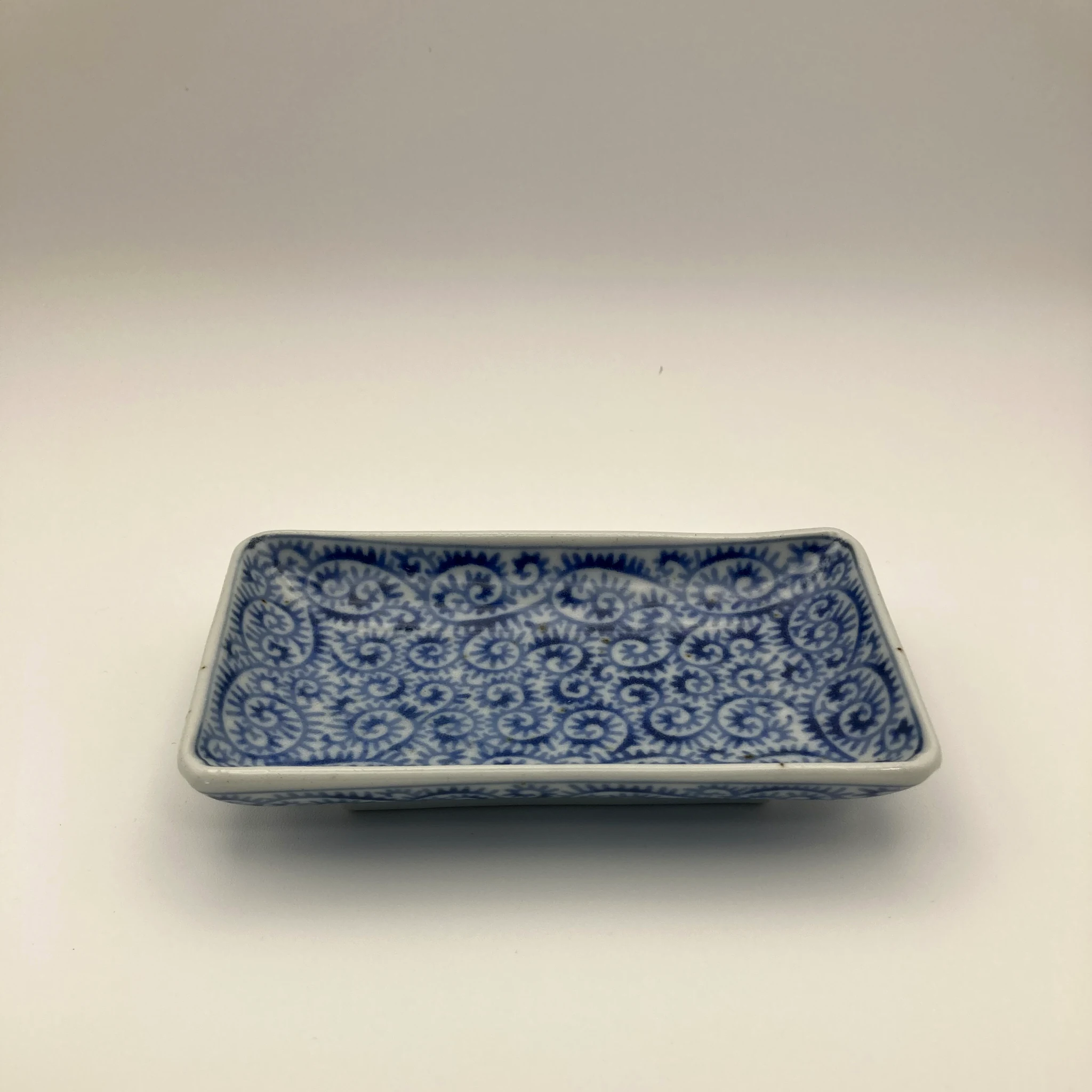
Set of 3 Antique Takokarakusa Rectangular Plates, Blue and White Octopus Scroll Kozara, Meiji Era Japan
Three small rectangular plates in the pattern Japan calls takokarakusa, octopus scroll. Look at the spirals for a second and you'll see it: curling arms covered in little suckers, repeating until they fill every corner.
Nobody knows who first decided an octopus should become wallpaper, but it stuck, and it's been drawn on Japanese porcelain for over three hundred years.
These three were made in the Meiji era, printed by hand through paper stencils rather than painted stroke by stroke. Run a finger over the surface and the blue sits under a smooth glaze flecked with tiny iron spots. Each plate is slightly different. The stencils shifted, the blue pooled differently, one is a touch deeper in tone than its brothers. That's how you know they weren't made yesterday.
The shape is a kozara, a small plate, in a rectangle that Japanese tables use for a slice of fish, a pickle, a piece of grilled something, or the soy sauce next to sushi. They stack neatly and take up no room.
Anecdotes
Takokarakusa was born in Arita in the 1600s and became such a workhorse pattern that by the Edo period it covered everything from soba cups to giant platters. There's an old dealers' saying that you can date a Japanese kitchen by its octopus scroll.
Stencil printing (katagami-zuri) was Meiji Japan's answer to demand. One skilled worker could decorate in a day what a painter did in a week. The funny thing is that the stencil pieces, once the cheap option, are now the ones with character. The little misalignments read as handwriting.
Fine for everyday food use. Hand wash recommended.
Measurements & materials
- Clay & glaze
- Grey-white porcelain body, clear glaze with scattered iron specks
- Kiln
- Seto or Mino (unmarked)
- Era
- Meiji to Taisho, c. 1880 to 1920
- Dimensions
- 13 x 8 cm each, 2.5 cm tall
- Weight
- 151 g (5.3 oz)
- Condition
- Very good. No chips or cracks. Kiln specks and light wear consistent with age Provenance: Antique shop find, central Japan
Ready to ship. Packed and sent from Japan.
- Found in Japan, and the only one of it we have
- Condition described honestly, flaws photographed
- Shipped insured and tracked, worldwide
- Payment handled by our provider - we never see your card
Return it within 7 days of delivery, unused and in its original packaging. Return postage is paid by you. Full policy.
Payments are handled by Stripe. Your card details go into Stripe's own secure form and straight to them: they never reach our servers, and we do not store them.
Ships from Japan. Cost is calculated at checkout from your address; import duties and taxes in your country are not included. Shipping & returns in full.
Looking after it
Recommendations
- Not dishwasher safe Heat, pressure and detergent together are what break old glazes.
- Hand wash in warm water
- Dry immediately, then air fully before storing Trapped damp is what turns into mould in a tomobako.
- Not microwave safe
- Not oven safe
- Not for direct flame or a stovetop
- Not freezer safe
- Avoid sudden changes of temperature Warm the piece with tepid water first rather than pouring boiling water into it cold.
- Gold or silver overglaze: never microwave Metallic decoration arcs in a microwave and the decoration is lost.
These are our recommendations after handling the piece, not a manufacturer's instruction. It is old, and it came with no paperwork.
More to discover
You may also like