








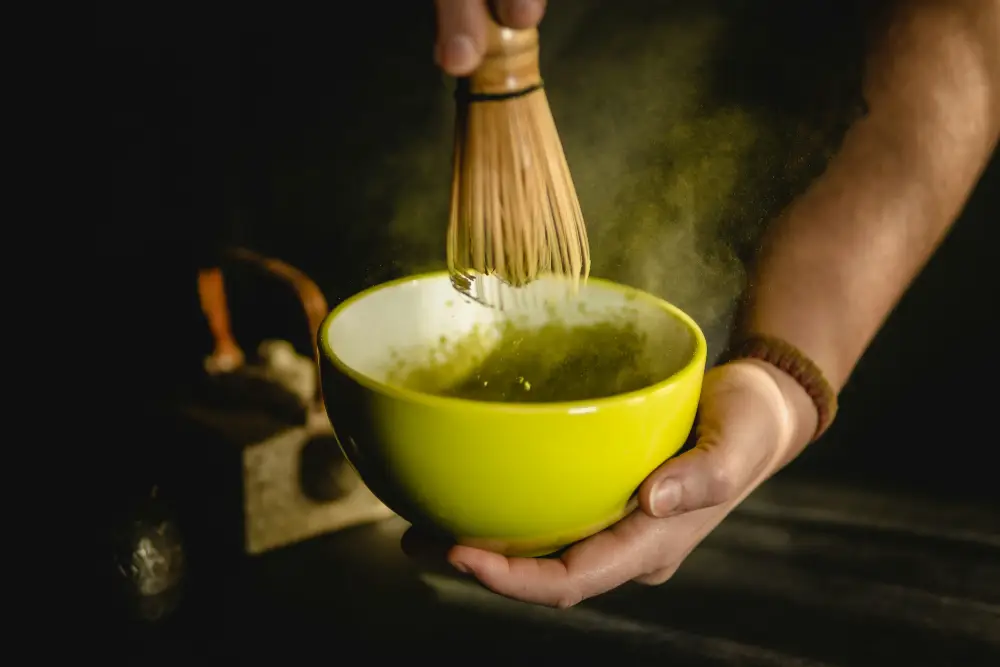
A matcha bowl, or chawan (literally "tea bowl"), is the wide, deep bowl used to whisk and drink powdered green tea in the Japanese tea ceremony. It is usually 11 to 15 cm across and 6 to 9 cm tall, with enough room for a bamboo whisk to move and a foot ring that is held when you lift it. Vintage chawan come from kilns like Hagi, Karatsu, Seto, Mino and Raku, each with its own clay and glaze character.
What is a chawan?
A chawan is a bowl made specifically for drinking matcha, whisked powdered green tea, rather than steeped leaf tea. The form has to do three things at once: hold roughly 60 to 80 ml of tea with room to spare, let a chasen (bamboo whisk) sweep the bottom without catching, and sit comfortably in two hands.
The anatomy has its own vocabulary. The kuchizukuri is the rim, the mikomi is the interior bottom where the whisk works, the koudai is the foot ring cut into the base, and the chadamari is the small well in the centre of the interior that collects the last of the tea. Potters are judged on all of these, and the foot ring most of all, because it is the one part left unglazed and honest.
Not every Japanese bowl is a chawan. Rice bowls, noodle bowls and serving bowls are built for food and generally read as too deep, too narrow or too thin-walled once you hold a real tea bowl. If you are browsing broadly, our bowls category covers the wider family, while a chawan is the specific tea form described here.
Chawan shapes and when each is used
Shape in a chawan is seasonal and practical, not decorative. The two shapes you meet most often are the summer hiradjawan and the winter tsutsujawan, with the everyday wan-nari in between.
ShapeFormWhen it is used Wan-nariStandard rounded bowl, slightly flaring rimAll year, the default form Hira-jawanWide and shallow, broad open mouthHigh summer: tea cools quickly Tsutsu-jawanTall cylinder, narrow mouthDeep winter: tea stays hot HantsutsuHalf-cylinder, between the twoLate autumn and early spring Kutsu-gata"Shoe shape", deliberately distorted oval rimAll year, associated with Oribe and ShinoFor a first bowl, a wan-nari or a slightly deep half-cylinder is the most forgiving. It whisks well, suits any month, and does not fight you while you are still learning the wrist motion.
Which kilns made vintage matcha bowls?
Most antique and vintage chawan on the Japanese market come from a handful of kiln traditions, and knowing their look is the fastest way to orient yourself. Each has a recognisable clay body and glaze behaviour that survives even on unsigned pieces.
- Hagi (Yamaguchi): soft pinkish-white clay under a milky, crazed straw-ash glaze. Hagi absorbs tea through the crackle and changes colour over years of use, a process called nanabake, "the seven transformations". Nearly always has a notch cut in the foot ring.
- Karatsu (Saga): grey-brown iron-rich clay, thin ash or feldspar glazes, often with simple brushed iron-oxide motifs (e-garatsu) or a split white-and-dark glaze (chosen-garatsu).
- Mino (Gifu): the home of Shino, thick white feldspar glaze with orange scorch marks and pinholes; Oribe, copper-green glaze with iron drawing; and Kiseto, yellow ash glaze.
- Raku (Kyoto): hand-moulded rather than thrown, low-fired, black or red, with a thick soft wall that insulates the hand. The archetypal tea ceremony bowl.
- Seto (Aichi): the oldest continuous glazed-ware centre in Japan, producing everything from iron-brown tea bowls to large volumes of everyday ware. Much of what we find around Nagoya and the Seto-Mino belt belongs here.
- Bizen (Okayama): unglazed, wood-fired stoneware with ash deposits and fire marks. Dense, heavy, and distinctive in the hand.
Kyoto workshops (Kyo-yaki and Kiyomizu-yaki) also produced large numbers of painted, refined chawan, often with seasonal motifs and gold enamel. These are the bowls most often found with a signed box, since the Kyoto trade has always sold through tea shops.
Antique, vintage or new: what changes
The practical difference is provenance and surface. A new matcha bowl is uniform, unused and replaceable; a vintage one carries a kiln history, tea staining, and in many cases the box and cloth it was sold with decades ago.
New productionVintage (roughly mid-20th century)Antique (pre-war and earlier) SurfaceClean, unglazed foot brightTea patina in the crackle, softened rimDeep staining, often repaired BoxUsually a plain boxOften a tomobako, the signed wooden storage boxBox may be later than the bowl ConsistencyHigh, made to orderVariable, one piece at a timeEach piece unique RiskLowHairlines, glaze lossesAttribution uncertaintyWe hunt the middle and left-hand columns of that table: bowls that were actually used, that show it, and that can still be whisked in every day. A bowl with fifty years of tea in its crackle is not damaged goods. That staining is the point, and in Hagi and Karatsu it is actively prized.
How to choose a matcha bowl
- Decide how you will use it. Daily whisking at the kitchen counter asks for a sturdy stoneware bowl you will not panic over. A display or formal piece can be finer and more fragile.
- Check the size against your hands. Around 12 cm diameter suits most people. Under 11 cm the whisk crowds the wall; over 15 cm the tea cools fast and the bowl becomes two-handed in an awkward way.
- Look at the interior bottom. It should be a smooth, shallow curve. Sharp angles, a raised ridge or heavy glaze pooling will shred a bamboo whisk.
- Turn it over. The foot ring tells you how the bowl was made, which clay was used, and whether the cutting was done with care. A sloppy foot on an otherwise elegant bowl is a warning.
- Weigh it. A good chawan feels lighter than it looks and balances near the foot. Top-heavy bowls are tiring to drink from.
- Accept honest repair. Kintsugi, lacquer repair dusted with gold, is a legitimate and valued part of a tea bowl's life. Ask what is underneath the gold, not whether gold is there.
- Read the box, carefully. A tomobako with a signature and seal adds a great deal when it matches the bowl. Boxes and bowls do get separated and recombined, so treat the box as evidence rather than proof.
Our broader buyer's guide to antique Japanese pottery goes further into marks, condition language and what to ask a seller before committing.
Signs of age on a vintage chawan
Age shows first in the unglazed foot and in the way glaze has aged, not in the decoration. Clay at the foot ring darkens and takes on a dry, slightly waxy feel from handling that new clay does not have.
In crackled glazes, the fine lines fill with tea and go from invisible to amber or grey-brown. On Hagi this is uniform and warm; patchy, sharply dark staining in one spot more often means a hairline crack rather than general use. Hold the bowl by the rim and tap it lightly: a clear ring suggests the body is sound, a dull thud warrants a closer look.
Wear on the rim, small glaze nibbles, and a softened chadamari where the whisk has worked for years are all consistent with a long-used bowl. Artificial ageing tends to be too even and too dark, and it rarely reaches into the foot in a convincing way.
Using and caring for a matcha bowl
Warm the bowl with hot water before you whisk, then pour it out and wipe dry: this keeps the tea hot and stops thermal shock on an old glaze. Add about 2 g of matcha, sifted, and 60 to 70 ml of water just off the boil, then whisk briskly from the wrist in a W motion until the foam is fine.
Wash with hot water and a soft cloth only. No detergent, no scouring pad, no dishwasher, no microwave. Porous wares such as Hagi and Bizen will take on soap and hold it, and crazed glazes can trap it in the crackle.
Drying matters more than washing. Let the bowl air-dry upside down on a cloth for a full day before boxing it, because a porous body sealed damp into a tomobako will grow mould. If a bowl develops a musty smell, leave it in the open air for a week before anything else.
A matcha bowl is also the anchor of a wider set: a chasen whisk, a chashaku bamboo scoop, a natsume tea caddy. If you are building out from the bowl, the rest of our vintage teaware and the guide to kyusu teapots cover the leaf-tea side of the same shelf.