









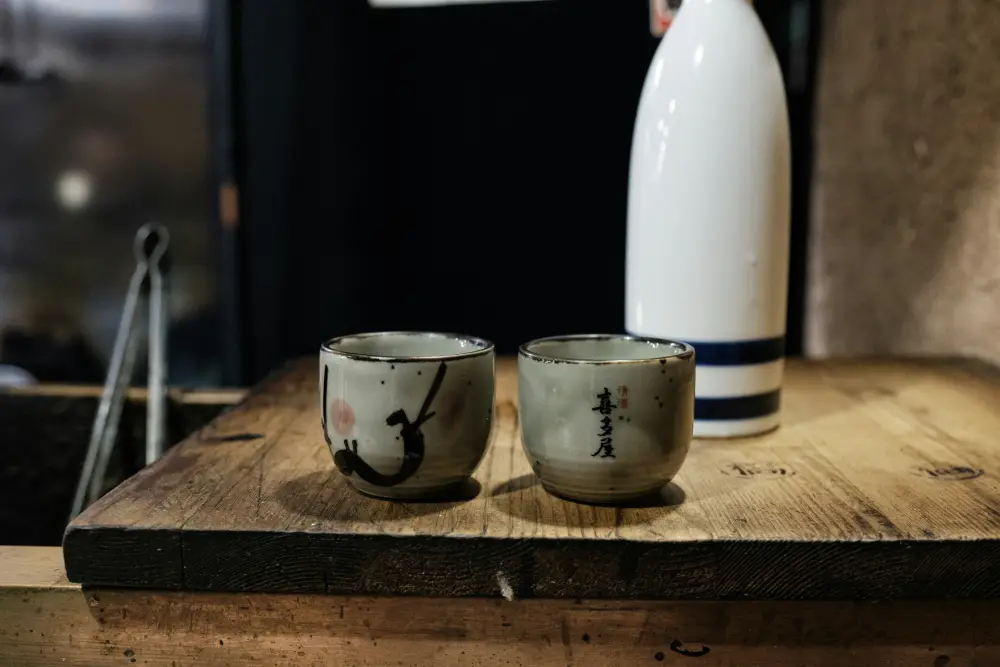
A Japanese sake cup comes in two main forms. An ochoko (お猪口) is the small, thimble-sized cup, roughly 30 to 60 ml, that is filled repeatedly from a tokkuri (徳利, the narrow-necked serving flask) at the table. A guinomi (ぐい呑み) is larger, usually 60 to 120 ml, and is held in the hand and sipped from rather than refilled constantly. The line between them is one of size and mood, not strict rule.
Ochoko vs guinomi: what is the difference?
The difference is size, weight and how the cup is used. An ochoko is poured for you and drained quickly, which keeps sake cold or warm and keeps the social ritual of pouring for others going. A guinomi is filled once, held, and drunk at your own pace, which suits a sake you want to think about.
The names hint at this. Choko derives from a word for a small vessel, with the honorific o attached; guinomi comes from gui to nomu, roughly "to drink in one go" or "to gulp". Despite that etymology, the guinomi is the slower cup in practice, because it holds more.
Ochoko Guinomi Typical capacity About 30 to 60 mlAbout 60 to 120 ml Wall thickness Often thin, light Often thicker, with weight in the hand Usual partner Tokkuri, poured by a companion Tokkuri, katakuchi (lipped pourer) or bottle Serving temperature Suits warm sake (kan)Suits chilled or room-temperature sake Common look Porcelain, blue and white, janome ring inside Stoneware, ash glaze, visible clay, uneven rim Sold as Often in sets of two or five usually singly, as a personal cup.Plenty of cups sit between the two categories, and Japanese sellers are not consistent about labels. If a cup is small enough that you would empty it in two sips, most people will call it an ochoko. If you can wrap your hand around it comfortably, it is a guinomi.
Other sake vessels you will meet
Beyond the two main cups, a handful of other vessels turn up in antique shops and are easy to confuse with them.
- Sakazuki (盃): a wide, shallow, flat cup, often lacquered or in porcelain, used for ceremonial toasts, weddings and shrine offerings. Wider than it is tall.
- Masu (枡): the square cedar box, originally a rice measure, used for sake at festivals and celebrations. Wooden, not ceramic.
- Katakuchi (片口): a bowl with a single pouring lip, used to serve chilled sake into cups.
- Tokkuri (徳利): the serving flask itself. We cover it in detail in our guide to vintage Japanese sake bottles.
What to look for in a vintage sake cup
Judge a sake cup with your hand first and your eye second, because it is a vessel you hold against your lip. Rim finish, weight and balance matter more than decoration.
- The rim. Run a fingertip around it. A good rim is smooth against the lip, whether it is a crisp porcelain edge or a soft, slightly wavy stoneware one. Chips on the drinking rim are a real fault; chips on the foot are usually cosmetic.
- The foot (kodai). The unglazed foot ring shows the bare clay and tells you the kiln and the firing. Grit, iron speckling and a trimmed spiral are all good signs of hand work.
- The interior. Light-coloured interiors let you see the sake's colour. Older mass-market ochoko often carry a janome (蛇の目, "snake eye") blue concentric ring inside, traditionally used by brewers to judge clarity.
- Weight and balance. Fill the cup mentally. A guinomi should feel settled in the palm; a top-heavy cup is tiring to hold.
- Crazing and staining. Fine crazing in the glaze is normal in older stoneware and not a defect. Deep brown staining along cracks can mean the body has absorbed liquid over decades.
- The box. A tomobako (共箱, the signed wooden storage box that came with the piece) supports attribution to a named potter, but most honest everyday cups never had one.
Kilns and glazes worth knowing
A few kiln traditions dominate the vintage sake cup market, and learning their surfaces makes shopping much faster.
Stoneware for guinomi
Bizen (Okayama) is unglazed, fired for days in wood kilns, and comes out russet, grey or scorched, with ash-melt patterns. Collectors prize Bizen guinomi because the coarse clay is said to soften sake. Shigaraki (Shiga) shows white feldspar grit bursting through an orange-brown body with green ash pooling. Hagi (Yamaguchi) has a soft, pale, crazed glaze that absorbs liquid and changes colour with use, an effect called nanabake, roughly "seven transformations". Karatsu (Saga) covers a range from plain ash glaze to iron-brown brushwork on grey clay.
Porcelain and glazed ware for ochoko
Arita and Imari porcelain gives the crisp blue and white ochoko most people picture, often with fine sometsuke (染付, underglaze cobalt) patterns. Kutani brings heavy overglaze enamel in red, green and gold. Seto and Mino, the kilns around Nagoya, produced enormous quantities of everyday cups, including Oribe green, Shino white and yellow Ki-Seto; we wrote more about that region in our piece on antique and vintage ceramics from Nagoya. Kyo-yaki and Kiyomizu-yaki from Kyoto lean refined and painterly.
Are sake cups sold in sets or singly?
Both, and the answer changes what you should expect to pay attention to. Ochoko frequently survive in sets of two or five, sometimes with their matching tokkuri, because they were bought that way for the household. Guinomi are traditionally personal objects and are collected one by one, each chosen for its own character.
Japanese sets usually come in fives rather than sixes, a habit tied to odd numbers being considered auspicious. If you find a set of five with the original box, check that all five actually match: shops often assemble near-misses from separate sets. Our guide to vintage Japanese sake sets goes through matching bottle and cups in more detail.
We hunt cups one at a time in antique shops and markets across Japan, so what turns up in the sake cups section is whatever the shops yielded that month, rather than a catalogue of matched sets.
How to use and care for a vintage sake cup
Treat a vintage cup as dishware that happens to be old: use it, but wash it by hand. Dishwashers batter rims and feet, and the heat cycle is hard on crazed glazes and on any overglaze enamel or gold.
- Before first use, soak porous stoneware such as Hagi or Bizen in clean water for ten to twenty minutes. A saturated body absorbs less sake and stains less.
- Warming. Heat the tokkuri in a water bath, not a microwave, and pour into a room-temperature cup. Sudden thermal shock cracks old glazes.
- Washing. Warm water, a soft cloth, no abrasive pads. Avoid soaking overnight, which drives odours into porous clay.
- Drying. Air dry upside down on a cloth until the foot is fully dry before storing, especially with unglazed Bizen, otherwise you risk mould in the clay.
- Gold and enamel. Kutani and Satsuma cups with gilding should never meet scouring powder or a dishwasher.
Staining and colour change in Hagi or Karatsu is not damage. Japanese collectors call the gradual patina from use keshiki, "landscape", and consider it the point of drinking from the cup rather than displaying it.
What vintage sake cups cost
Price tracks maker, kiln and condition rather than age. An unsigned mid-century Seto or Mino ochoko is an inexpensive everyday object; a signed guinomi by a recognised Bizen or Hagi potter, with its tomobako, sits in an entirely different bracket.
Three things reliably add cost: a documented maker, an intact original box, and a flawless drinking rim. Three things reliably do not: general age, a stamped kiln mark of an unidentified workshop, and crazing. If you are new to judging this, our buyer's guide to antique Japanese pottery covers marks, repairs and condition language in more depth.