








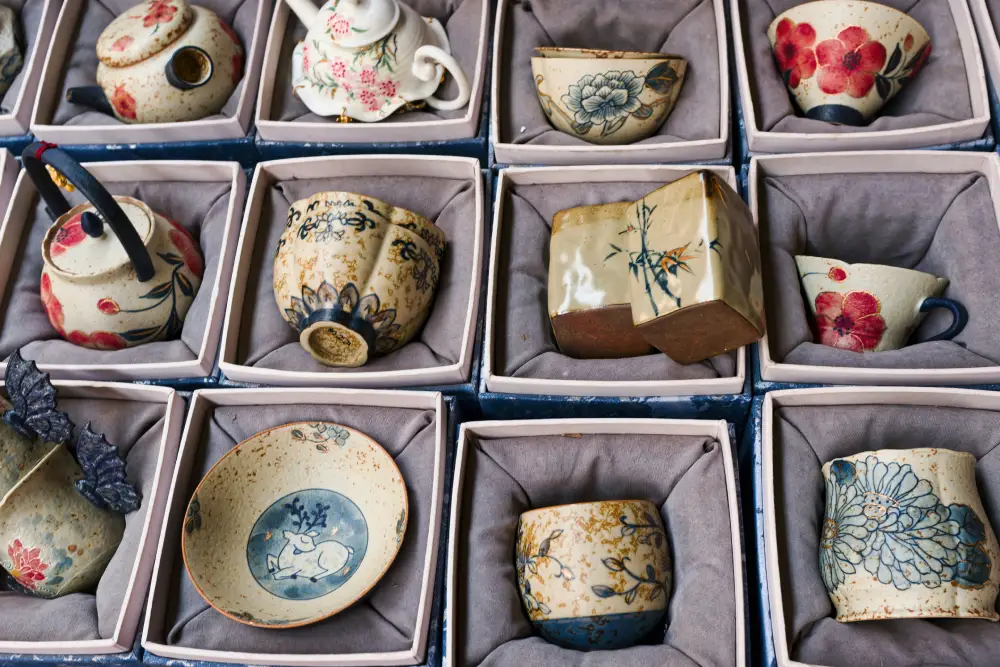
A yunomi (湯のみ, literally "hot water drinker") is the everyday Japanese tea cup: taller than it is wide, with no handle and no saucer, made for green teas such as sencha and bancha. Most hold roughly 150 to 250 ml. It is the cup used at home and at the counter of a sushi restaurant, as opposed to the wide bowl used for whisked matcha.
What is a yunomi?
A yunomi is a handleless ceramic cup for brewed green tea, usually cylindrical or gently flared, with a small foot ring and an unglazed or lightly glazed base. The form is defined by use: you hold it with the fingers around the body and the thumb at the rim, so the walls must be thick enough, or the glaze insulating enough, that the cup can be picked up when full of hot tea.
The word covers a wide family. A yunomi-jawan is the full term, "hot water drinking bowl", and you will see it on old boxes and shop labels. A taller, narrower version is often called a tsutsu-yunomi (cylinder cup), which keeps tea warmer and suits bancha and hojicha. A small, thin-walled, wide-mouthed cup for high-grade sencha or gyokuro is a senchawan, closer in spirit to a Chinese tea cup.
Yunomi are frequently made in pairs called meoto (husband and wife), one slightly larger than the other. Finding a surviving pair in an antique shop is less common than finding singles, since cups break one at a time.
Yunomi vs chawan vs guinomi: which cup is which?
The difference is volume and the drink it serves. A yunomi is a tall cup for leaf tea, a chawan is a wide bowl for whisked matcha, and a guinomi or ochoko is a small cup for sake. Dealers in Japan sort them this way, and so should you when reading a listing.
VesselTypical capacityShapeUsed for Yunomi150 to 250 mlTall, handleless, straight or flaredSencha, bancha, hojicha, genmaicha Senchawan40 to 90 mlSmall, shallow, thin wallsGyokuro and high-grade sencha Chawan300 to 500 ml brimfulWide bowl, low and openWhisked matcha Guinomi / ochoko30 to 80 mlVery small cupSakeBorderline pieces exist. A large guinomi and a small senchawan can look almost identical, and plenty of Japanese households use whichever cup is nearest. If you want the background on the other two families, we have written separately about vintage matcha bowls and about ochoko and guinomi sake cups.
Kilns and styles you will meet
Almost every Japanese pottery region makes yunomi, because every region drinks tea. A handful of kiln traditions account for most of what turns up in antique shops.
Mino and Seto
The kilns of Gifu and Aichi have produced the bulk of Japan's everyday tableware for centuries, and most unmarked vintage yunomi come from here. Look for Oribe green copper glaze, Shino white feldspathic glaze with its soft pitting and orange scorch, Ki-Seto yellow, and Setoguro black. Mino ware is also where you find the cheerful mid-century patterned cups that fill household cupboards.
Tokoname and Banko
Both are known first for teapots, and their cups are usually sold as part of a tea set. Tokoname red clay (shudei) cups are unglazed inside and out, warm orange-brown, and are said to soften the astringency of sencha. Banko ware from Mie uses a purple-brown clay and often shows fine turned ribbing. If you are assembling a set, our guide to Tokoname and other vintage kyusu teapots covers the matching pots.
Hagi, Karatsu and Kyoto
Hagi ware from Yamaguchi is soft, pale and absorbent, with a crackled glaze that stains with use into the patina collectors call nanabake, the "seven changes". Karatsu from Kyushu is earthier, often with iron-brown painting under an ash glaze. Kyo-yaki and Kiyomizu-yaki from Kyoto are the refined end: thin porcelain or fine stoneware with painted and gilded decoration, frequently signed and boxed.
Arita, Hasami and Kutani porcelain
Porcelain yunomi are lighter, thinner and non-absorbent, which means they also get hotter in the hand. Arita and Hasami in Kyushu produce blue-and-white sometsuke cups, often with repeating patterns such as karakusa vine scroll or tako-karakusa. Kutani from Ishikawa is the colourful one: deep overglaze reds, greens and gold, sometimes covering the whole surface.
How to choose a vintage yunomi
Choose with your hand, not only your eyes. The cup you reach for every morning is the one that balances well and does not scald your fingers, and that is something you can judge from photographs and measurements if you know what to look at.
- Capacity. Around 180 ml suits most daily drinking. Under 120 ml means refilling constantly; over 300 ml and the tea goes cold and bitter before you finish.
- Wall thickness and material. Thick stoneware and unglazed red clay stay comfortable to hold. Thin porcelain transmits heat fast, so check the cup has a decent foot ring or a flared rim to grip.
- Rim shape. A slightly flared or rolled rim sits more kindly on the lip and makes the cup easier to lift. A knife-sharp rim on thin porcelain can feel cold and brittle.
- Interior glaze. A pale interior lets you see the colour of the tea, which matters more than people expect with sencha. A crazed interior will stain over time, which is desirable in Hagi and less so in a white porcelain cup.
- Foot and base. Turn it over. The unglazed foot shows the clay body and the throwing marks, and tells you more about origin than the decoration does.
- Condition. Check the rim under raking light for flea bites, and listen for a dull note when the cup is tapped, which can indicate a hairline crack.
Marks, boxes and signatures
Most vintage yunomi are unmarked, and that is normal rather than a warning sign. Everyday tableware was produced by workshops in quantity and rarely signed; only studio pieces and better kiln work carry a potter's stamp or a painted mark on the base or foot ring.
When a mark exists it is usually a small impressed seal (kamain, kiln seal) or two or three brushed characters. A piece sold with a tomobako, the signed paulownia wood box made for it, is a stronger signal: the lid gives the potter's name, the form and often a seal in red. Boxes do get separated from cups and swapped, so treat box and cup as two pieces of evidence rather than one. Our buyer's guide to antique Japanese pottery goes into marks and dating in more detail.
Caring for a vintage tea cup
Wash by hand in warm water, with little or no detergent, and dry before putting the cup away. Old glazes, overglaze enamels and gilding do not survive dishwashers, and absorbent stonewares such as Hagi will take up dish soap and release it into your tea.
Porous cups benefit from a soak in plain warm water before first use, which stops them pulling the first mouthful of tea into the clay. If your cup has a crazed glaze, expect the lines to darken over the years: that is the intended life of the piece, not damage. Avoid microwaves entirely with gilded or silvered decoration, and never put a cold cup straight under boiling water if it is thin and old.
Buying a vintage yunomi
Vintage yunomi are among the easiest ways into Japanese ceramics: they are small, they are plentiful in Japanese antique shops, and they are made to be used daily rather than displayed. A cup that has already been in service for fifty years has proved it can take the handling.
We hunt for pieces one at a time in antique shops around Japan, so what we find is whatever the shops yield that month: single cups, occasional meoto pairs, stoneware and porcelain alike. Our tea cups and the wider teaware section are where those finds go, and the way we source explains why each listing is a single piece rather than a repeatable product.